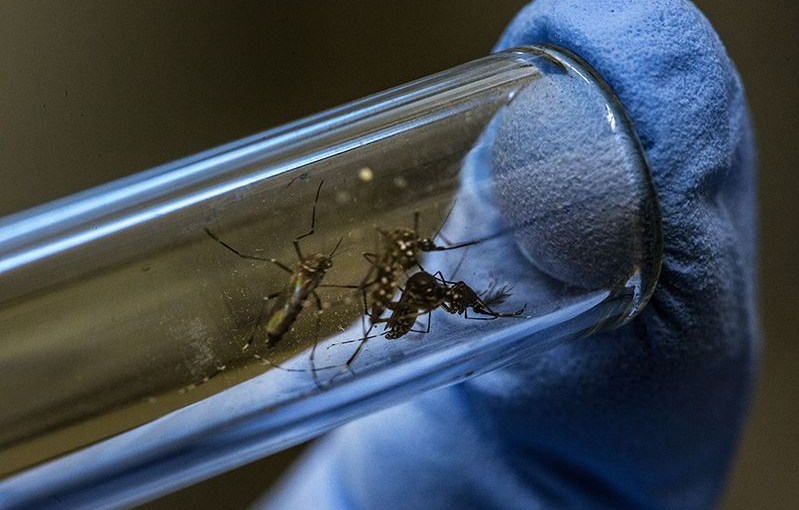
Almost four years ago scientists intentionally released millions of mosquitoes onto an Australian city in an effort to lower the incidence of arboviruses (viruses like Dengue and Zika that can be transmitted via the bite of a mosquito). While adding more mosquitoes to the population may seem counterintuitive, the addition of these insects actually did help to lower the rate of transmission of at least one arbovirus. However, viral prevention wasn’t due to just having more mosquitoes around but moreso due to the bacteria these new mosquitoes were carrying.
The mosquitoes of interest were infected with Wolbachia spp. an insect-specific bacterium that has been known for a long time to cause cytoplasmic incompatibility between mating mosquitoes. This means that if an uninfected female mates with a Wolbachia-infected male, the resulting offspring will not be viable. Additionally, Wolbachia infection has been shown to shorten mosquito lifespan and lower the viral infection rates of the mosquitoes themselves. Taken together this bacterium offers an attractive and novel solution for controlling the spread of arboviruses especially given that current prevention methods like insecticides, mosquito nets, and crude treatments and vaccines, are not fully effective.
The aforementioned study, spearheaded by Scott O’Neill at Monash University, utilized Wolbachia as a method of controlling arbovirus spread and the results from this roughly four year trial hold promise. The study followed the number of cases of Dengue, an arbovirus that causes mostly mild symptoms but can be fatal especially for children, after the release of Wolbachia-infected mosquitoes. Only 4 cases of Dengue were locally acquired in the 4 years following mosquito release verses 54 cases in the 4 years prior. These results become more exciting when you consider that Wolbachia infection can lower the rate of multiple arboviruses simultaneously. Although the study did not report on the incidence of other arboviruses like Zika virus and chikungunya virus, it would not be surprising to see the infection rate of these pathogens also decrease following mosquito release.
While complete eradication of the arboviruses is an enticing scenario, much more work needs to be done before this goal can come to fruition. To address this, there are multiple ongoing large-scale studies investigating Wolbachia as a means of arbovirus control especially in regions with high incidences of disease. Additionally, Wolbachia infection is also being studied for its efficacy against preventing the spread of Malaria. While Malaria is not caused by an arbovirus but instead results from infection of the Plasmodium parasite, it is still spread primarily through the bite of a mosquito and therefore could theoretically be influenced by Wolbachia infections in host mosquitoes. The results from this study are just the beginning and offer hope that someday mosquito bites can evolve from the life-threatening events they currently are for so many people to minor inconveniences.
Ashley
(Picture from Dado Galdieri featured in Nature)

 Science Blogs from Zani Brainy